

Composite Theories: Jacques Hadamard

To seriously study creativity, it is useful to know something about the first scientific efforts to define and explain it, attributable to psychology.
-
Step 1: Small doses...visuals!
The idiosyncrasies, concepts and language of mechanical engineering are somewhat distant from the psychological approach and it is easy for the reader to lose the thread of the explanations by becoming entangled with its specific terminology and its forms of expression.
For this reason, I have preferred to extract small fragments of the theories of creativity and make an effort to create my own graphic image for them.
My graphics involve the risk of biasing and/or distorting the original ideas, which also exists when trying to paraphrase them, but it brings the will to understand them and translate them into engineering language in the hope of bringing both approaches closer together.
To this end, I have relied on research works that compile and summarize these theories. In particular, the work of authors Busse & Mansfield that appears in the quotes in the next step of the tutorial.
-
Step 2: Composite Theories: Jacques Hadamard
Busse & Mansfield (p. 51) cite the theory of Jacques Hadamard (The psychology of invention in the mathematical field, 1945) as an evolution of that of Graham Wallas (The art of thought, 1926) combining previous theories and with emphasis on association of ideas. It illustrates the idea of the “iceberg” that Freud associated with the conscious, preconscious and unconscious levels of the mind.
References:
- Busse, T. V., & Mansfield, R. S. (1984). Teorías del proceso creador: revisión y perspectiva. (©. 2.-2. reservados, Ed.) Studies in Psychology = Estudios de Psicología, nº 18 (traducido del Journal of Creative Behavior, num. 2, vol. 14, 91-103, 1980), 47-57. Recuperado el 18 de diciembre de 2020, de https://dialnet.unirioja.es/ejemplar/7049
- Hadamard, J. (1945). The psychology of invention in the mathematical field. Princeton: Princeton University Press.
- Wallas, G. (1926). The art of thought. Nueva York: Harcourt. Brace.
-
Step 3: My graphic interpretation
Composite Theory: Jacques Hadamard (1945)
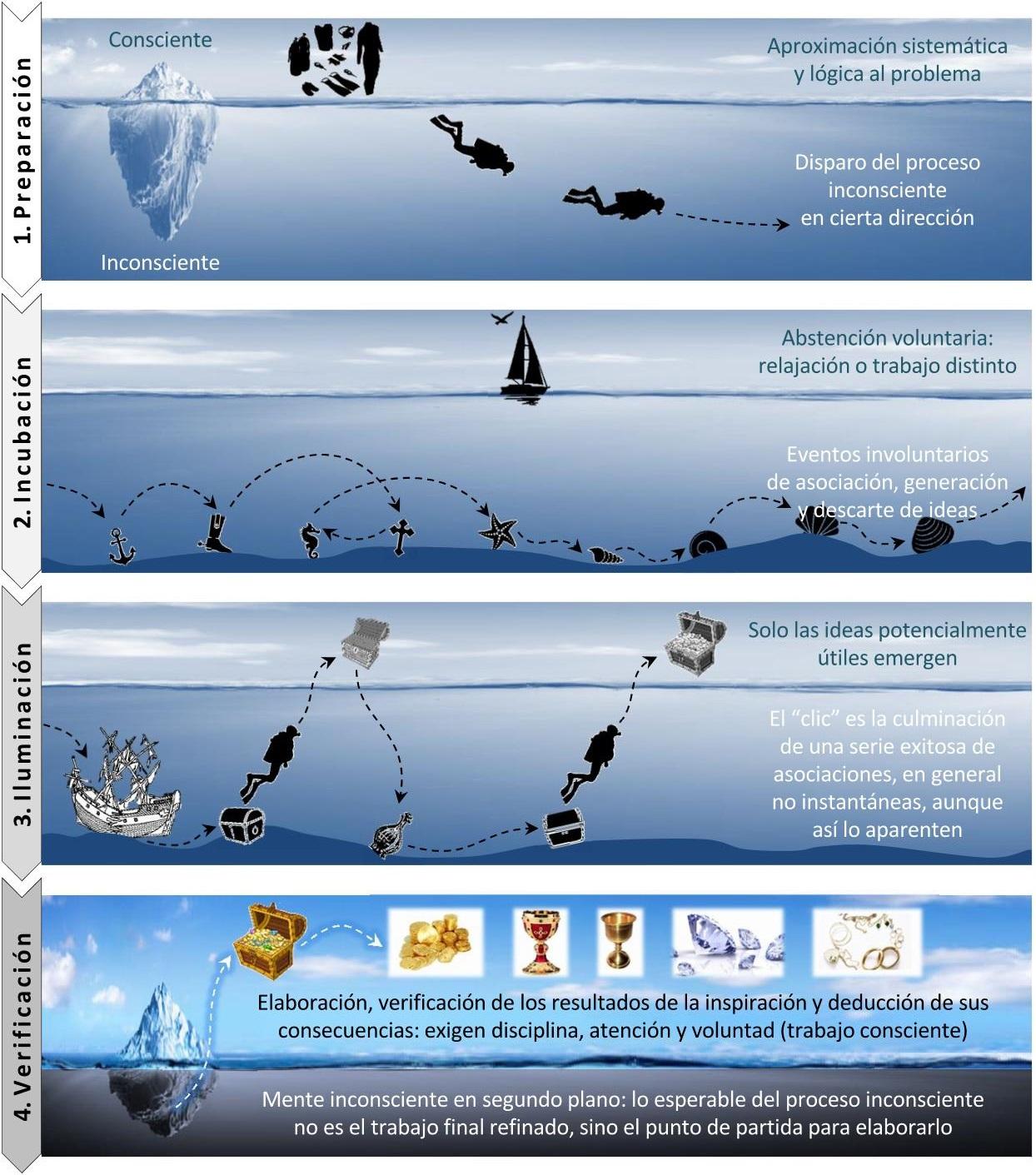
Some text from the figure:
1. PREPARATION:
On the surface: Conscious; Systematic and logical approach to the problem.
In the depths: Unconscious; Triggering of the unconscious process in a certain direction.
2. INCUBATION:
On the surface: Voluntary abstention: relaxation or different work.
In the depths: Involuntary events of association, generation and discarding of ideas.
3. LIGHTING:
On the surface: only potentially useful ideas emerge.
In the depths: the "click" is the culmination of a successful series of associations, generally not instantaneous, although they seem that way.
4. VERIFICATION:
On the surface: Elaboration, verification of the results of inspiration and deduction of its consequences: they require discipline, attention and will (conscious work).
In the depths: Unconscious mind in the background: what is expected from the unconscious process is not the final refined work, but the starting point to elaborate it.
Note. 4-stage process with a preponderance of the unconscious and association. Source: illustration by the author based on the “iceberg” that Freud used to explain his theories of the mind.
Reference: all texts and images in this tutorial were extracted from the doctoral thesis cited below,
- Valderrey, M.E. (2021), “Catalizadores Creativos en Ingeniería Conceptual: Evaluación de Habilidades Visuales y Verbales para Diseño Mecánico”. Propuesta de tesis doctoral, UNINI-México.
-
Step 4: Links
This tutorial comes from:
Theories of Cognitive Development: David Feldman
and continues in:

