


Creating a universal system

I am currently exploring the development of a standardized bolting system that could provide a universal method for selecting and applying bolts across different situations. The idea is to create a structured approach where bolts are categorized by strength and application requirements, ensuring clarity and consistency when determining which bolt should be used.
For example, if one application requires support for a 100 lb load, and another requires 200 lbs, this system would guide users toward the appropriate choice without ambiguity. I would greatly value any creative ideas or insights on how such a universal system could be designed and implemented effectively.
Accepted answer

Owww, got ya.
In my experience, the standardization of parts or assemblies often fails due to CAD internal structural issues. I think this is one of the most common reasons why businesses invest in PDM or ERP systems. I've seen many approaches to solve this problem, but to bring it to a 100% stable process usually takes a million and one resources.
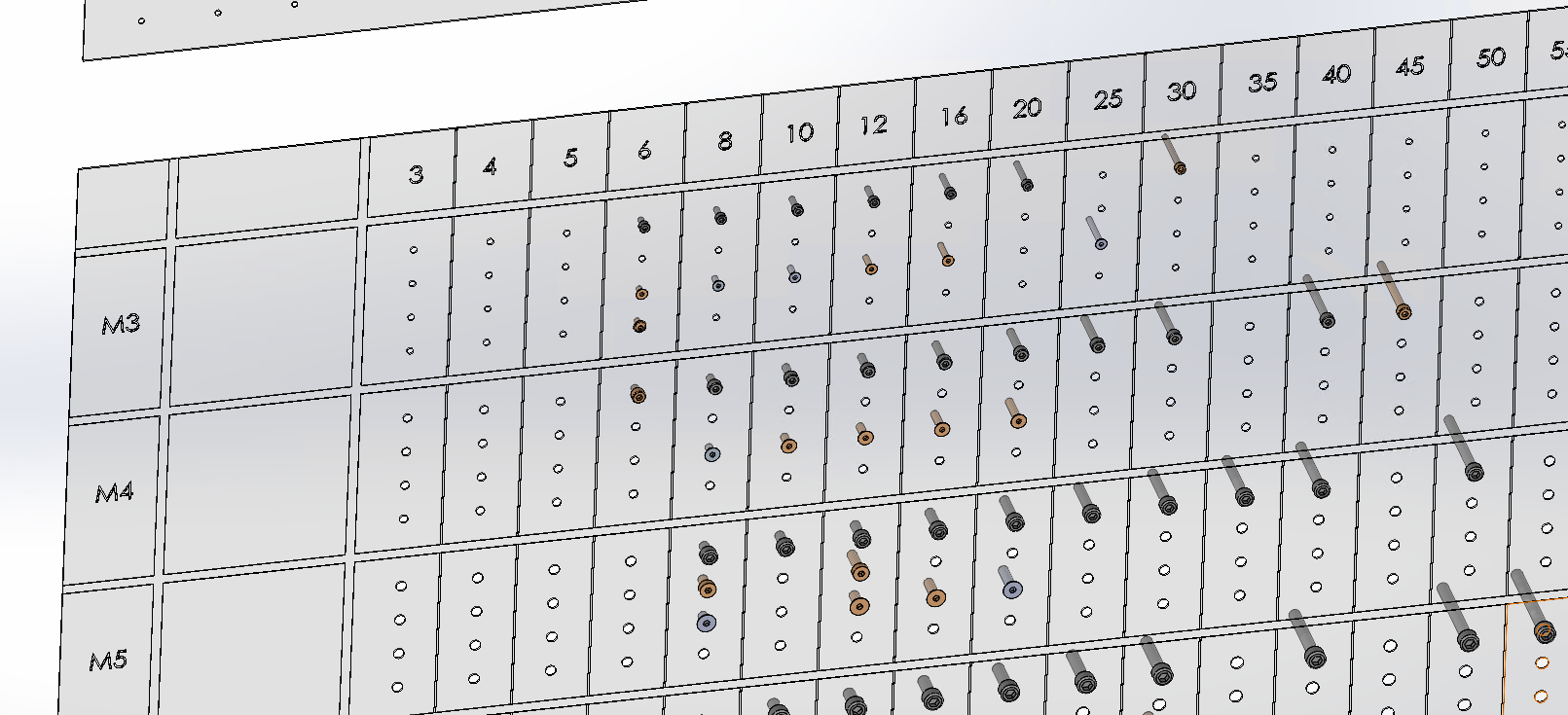
My personal best practice recommendation, which I also used in my own company, is to build visual libraries. For example, I have a bolts-and-nuts library (I attached a screenshot). If you need a bolt, you just copy & paste it into your assembly document.
Some additional thoughts focusing on SMB demands:
- If the only way to search for parts is by naming or description, a simple typo can make it vanish into a black data hole. Keeping component data consistent—especially for internal standard parts—is, in my opinion, one of the most (if not the most) important things.
- You should consider maintaining an additional documentation that describes all available variants of your standardized components. This helps you keep track of existing variants and makes it easier for new employees or external partners to get started.
- If you’re able to identify the components you want to standardize at an early stage of your business, from a CAD perspective I strongly recommend creating the most perfect template of your standard part possible. I did that with strut profiles and it saved me a million hours of work (we can discuss this in detail if you're interested =D).
- In my experience, it’s nearly impossible to initially create all variants you will need later on. I’d prefer, as mentioned, to create a new standard when necessary by using the template and add the new standard in that tracking document. In my opinion, this is more efficient than trying to create everything at once (beside purchased part varaints like the strut profiles)
2 Other answer
Hey Colby,
would you mind describing the process in a bit more detail? I'm specialized in automating assembly processes, including manual workstations as well as automated cells like press, screw, or robot stations. From my personal experience, if you have a wide range of products and need maximum flexibility in terms of assembly variants, the best approach in my opinion is a "pick-by-light" workstation. I've designed this both with a "next step" button and with a light-barrier-monitored system that verifies that the operator has picked the correct part from a particular box.
I’m starting a company and want to design a future-proof system for bolts. Instead of creating a new bolt design for every application, I’d like to develop a standardized list of bolts, each rated for different strengths and uses. That way, people can simply choose the appropriate bolt from the list rather than designing custom ones. How should I structure this list of bolt types and ratings to make it practical, efficient, and adaptable for different applications Or even different Fields?

