

Single-Beam & Multi-Beam Echo Sounders

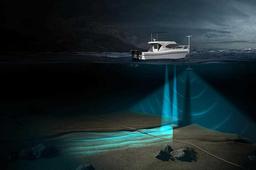
Hydrographic Surveying with Single Beam Echo Sounder (SBES) & Multi Beam Echo Sounder (MBES).
-
Step 1: Single-Beam Echo-Sounder
Hydrographic Surveying Single Beam Echo Sounders (SBES), also known as depth sounders or fathometers determine water depth by measuring the travel time of a short sonar pulse, or “ping”. The sonar ping is emitted from a transducer positioned just below the water surface, and the SBES listens for the return echo from the bottom. In reality, the sonar energy will be reflected by anything that may be in the path of the sound – fish, debris, aquatic vegetation and suspended sediment. Hydrographic survey grade single beam echo sounders are able to provide accurate bottom depths by distinguishing the real bottom from any spurious signals in the returned echo. True survey-grade hydrographic single beam echosounders record a digital water column echogram or echo envelope, that provides a graphical representation of the return echo.

-
Step 2: SBES Frequency
Sonar is characterized by the frequency by which the sound wave is broadcasted. A low frequency gives a greater range but less resolution. Similarly, a high frequency gives a smaller range but a higher resolution. Typically used frequencies during hydrographic surveying are in the range of 200-400 kHz.
SBES may use various different sonar frequencies; typically 200 kHz is used in shallow water under 100m. As the attenuation of sound in water decreases at lower frequencies, 24-33 kHz is commonly used for deeper water surveys.

-
Step 3:
Single beam echo sounders offer significant cost savings compared to multibeam echosounder systems and are especially useful in very shallow water, under 5-10m depth. Results from single beam echosounders are easier to interpret, far less time-consuming to edit, and the SBES equipment may be operated by less experienced personnel.
-
Step 4: Bar Check for Calibration and Sound Velocity
A large source of error in single beam echo sounder hydrographic surveys is an incorrect speed of sound used in the depth calculations. To ensure the correct sound velocity (SV) is used, a bar check should be conducted before the survey commences. The bar check involves lowering a flat plate below the echo sounder transducer to several known depths below the surface and comparing the actual versus measured depth. As the bar is moved down, the sound velocity in the echo sounder is adjusted until the measured depth matches the actual depth.
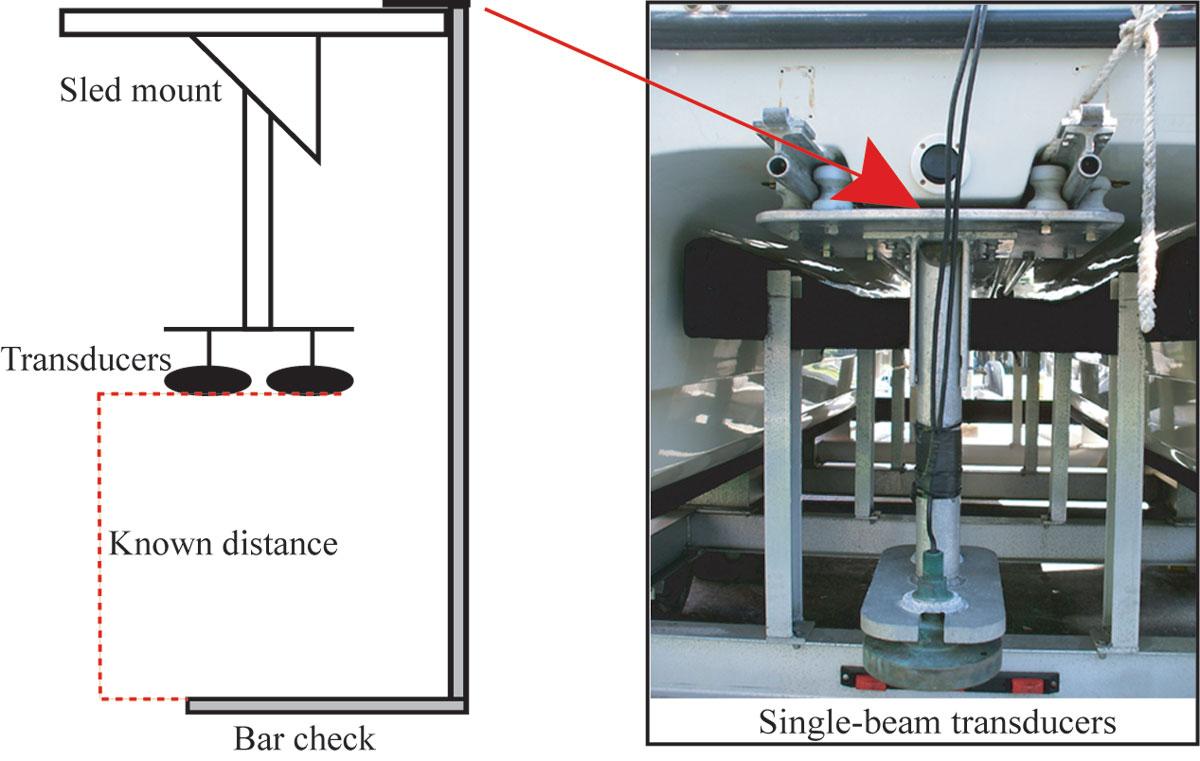
While a bar check calibration should be a mandatory procedure before a survey to check the instrument operation and set the average sound velocity (SV)
-
Step 5: SBES Kit
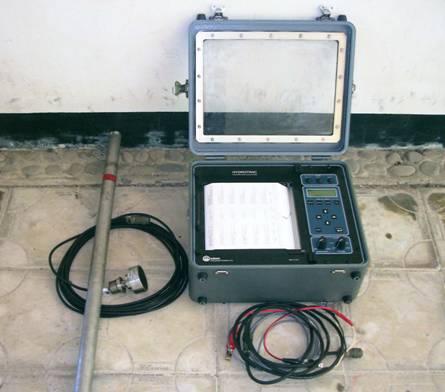
Single-Beam Echo-Sounder Kit for Hydrographic Survey
- Precision survey echo sounder
- GPS antenna
- Transducer
-
Step 6: Multi-Beam Echo-Sounder
A Multibeam echo-sounder is a type of sonar that is used to map the seabed. Like other sonar systems, multibeam systems emit acoustic waves in a fan shape beneath the transceiver of the multibeam echosounder. The length of time it takes for the sound waves to reflect off the seabed and return to the receiver is used to calculate the water depth. Unlike other sonars, multibeam systems use beamforming to extract directional information from the returning soundwaves, producing a swath of depth readings from a single ping.

Multibeam is therefore much more efficient compared to the single-beam echo-sounder, especially if you want to make a hydrographic survey with 100% seabed coverage. Unlike the single-beam echo-sounder, that emits a single wide beam at the seabed, the multibeam is capable of receiving several separate beams. These beams (sound waves) are received in a fan-shaped pattern, enabling the system to collect depth profiles across the sailing direction.
-
Step 7: Multi-Beam Resolution
Multibeam is able to acquire up to 512 separate soundings in each depth profile. This provides a resolution that by far exceeds what you find by use of a singlbeam echo-sounder. When surveying in 10 m of water the system will collect a sounding for every 7 cm across track (transverse to the sailing direction).


