Learn about the GrabCAD Platform
Get to know GrabCAD as an open software platform for Additive Manufacturing
Visit our new homepage
Home
Control
Shop
Streamline Pro
Partner Program
Print
Community
Log in
Library
Challenges
Groups
Questions
Tutorials
Engineers
Blog
Log in
Learn from thousands of free Tutorials.
New user?
Join the community
or
log in.
Tutorials
Most liked all time
Recent
Most liked
Most viewed
Most commented
This week
This month
All time
Category
Design & CAD
Modeling
Drafting
Assemblies
BOM
Dimensioning / Tolerancing
Translations
Manufacturing & CAM
3D Printing
Tooling
NC Machining
Composites
Measurement / Inspection
Simulation & CAE
FEM
CFD
Kinematics
Process Simulation
Engineering Fundamentals
Theory
Process
Standards
Other
Software
Snagit
Alibre Design
ArchiCAD
AutoCAD
AutoCAD Electrical
Autodesk 3ds Max
Autodesk Alias
Autodesk Inventor
Autodesk Maya
Autodesk Revit
Autodesk 123D
BricsCAD
Bentley MicroStation
BlenderCAD
BobCAD-CAM
CATIA
Delmia
DraftSight
FreeCAD
Femap
Fusion 360
Geomagic Design
IronCAD
JT
Kompas-3D
KeyCreator
KeyShot
Lagoa
Luxology
Mastercam
Moi3D
NX Unigraphics
OBJ
Onshape
OpenSCAD
Parasolid
Powermill
Powershape
Pro/Engineer Wildfire
PTC Creo Parametric
PTC Creo Elements
Rhino
SpaceClaim
SOLIDWORKS
solidThinking Evolve
Solid Edge
SolidFace
STEP / IGES
SketchUp
STL
TopSolid
TinkerCAD
T-Flex CAD
TurboCAD
VectorWorks
ViaCAD 3D
VRML / WRL
ZW3D
GrabCAD Print
Rendering
GrabCAD Community
GrabCAD Workbench
Text file
3D Manufacturing Format
Cinema 4D
Other
Skill level
All levels
Beginner
Intermediate
Expert
weldingengineer
×
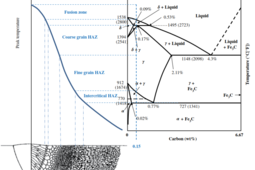
Microstructural and Mechanical Changes in the Weld Metal, Heat-Affected Zone (HAZ), and Fusion Boundary
Aygün Karaköse
in
Theory
3
0
Intermediate
Welding is a widely used process in manufacturing, construction, and heavy industry. During welding, the material is exposed to localized high temperatures that significantly affect not only the weld metal but also the surrounding regions. These include the Weld Metal, the Heat-Affected Zone (HAZ), and the Base Metal. Each of these zones undergoes different thermal cycles and consequently exhibits different microstructural transformations, mechanical properties, and residual stresses. Understanding these transformations is crucial for ensuring the integrity and performance of welded components.
heat
haz
wewlding
weldingengineer
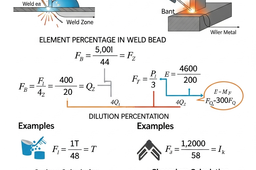
How to Calculate Element Percentage in Weld Bead Using Dilution Formula
Aygün Karaköse
in
Theory
3
0
Expert
This tutorial explains how to calculate the percentage of a specific alloying element (e.g. C, Mn, Cr, Ni) in a weld bead based on contributions from base metal, filler metal, and other additives. This calculation is critical in welding metallurgy to predict the final chemical composition of the weld and ensure mechanical properties meet standards.
weldingengineer
weld
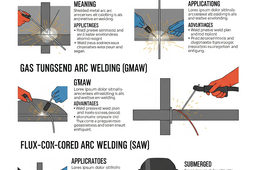
Electrode and Wire Classifications in Arc Welding: A Technical Overview
Aygün Karaköse
in
Theory
1
0
Intermediate
arc welding processes such as SMAW (Shielded Metal Arc Welding), MIG (Metal Inert Gas), TIG (Tungsten Inert Gas), and MAG (Metal Active Gas), electrodes and wires are classified and coded according to international standards. These designations help welders select the appropriate consumables to ensure weld quality and suitability for specific applications. This article explains common electrode and wire classification systems with representative examples and their meanings.
weldingengineer
weld
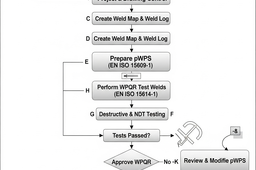
Welding Procedure Development Workflow According to EN ISO Standards: A Comprehensive Guide
Aygün Karaköse
in
Theory
1
0
Expert
Welding procedure development is a critical process to ensure quality, safety, and repeatability in welded fabrications. The workflow is governed by international standards such as EN ISO 15607, 15609, 15614, 15610, and 15608, which set requirements for qualification, documentation, and testing of welding procedures. This article outlines a step-by-step roadmap for welding procedure development, from material verification to final approval, tailored for welding engineers and quality professionals.
weldingengineer
welding
A Technical Review on Weld Joint Preparation Designs, Welding Processes, and Welding Positions
Aygün Karaköse
in
Theory
0
0
Intermediate
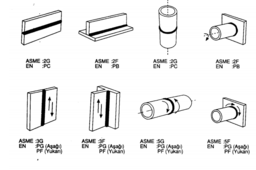
Welding is an indispensable joining method in modern manufacturing and construction. The quality of a welded joint is influenced not only by the welder’s skill but also by the proper selection of the welding process, welding position, and most critically, the weld joint preparation. The geometry of the joint preparation directly affects the penetration depth, heat distribution, weld metal behavior, and the presence of welding defects. This paper presents a technical review of weld joint designs, welding process classifications, and welding positions in accordance with EN ISO 9692 series, EN ISO 4063, and EN ISO 6947 standards.
weldingengineer
weld
🔧 Arc Transfer Modes in MIG Welding: Short Arc, Spray Arc, and Globular Transfer
Aygün Karaköse
in
Theory
0
0
Expert
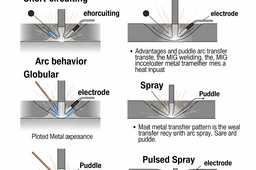
MIG (Metal Inert Gas) welding has become one of the most widely used welding processes in modern industry due to its high efficiency, automation capability, and compatibility with various materials. However, the type of arc transfer used in MIG welding plays a critical role in welding performance and quality. In this article, we explore the three main arc transfer modes in MIG welding: Short Arc, Spray Arc, and Globular Transfer — each with its own advantages and limitations. 🎯
mig
weld
weldingengineer