how to do it

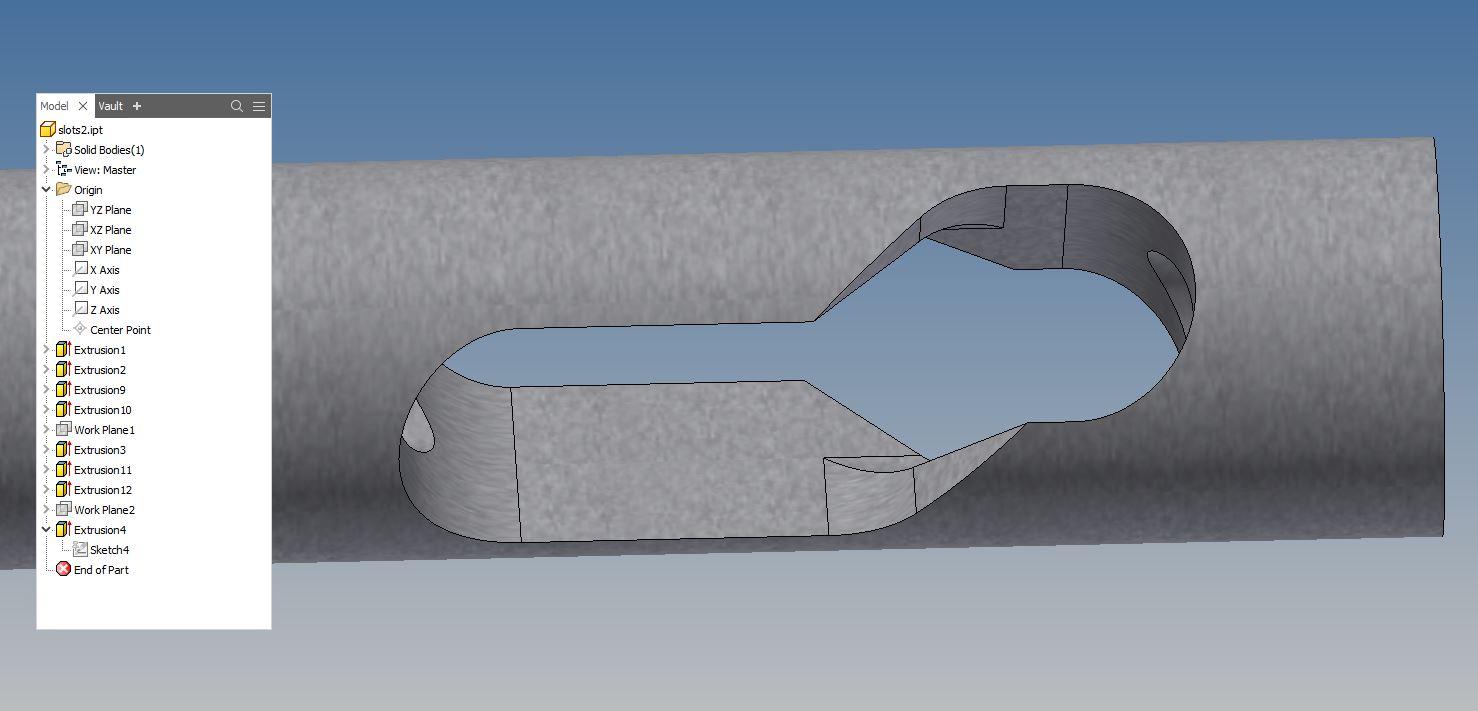
Hello, I need help your help. Please see attached a picture. I am going to do like that using extrude or sweep features in Autodesk inventor but don't know how to do like it.
4 Answers
This the file I am going to extrude. Can you finish it like you.

I started to edit your file but it would have resulted in a mess. There are very few constraints in what you have done. It would be difficult to make any edits without throwing something out of alignment. You should never leave sketches unconstrained like this. It's best to start on the default XYZ work planes. My number one suggestion would be constrain everything on each and every sketch before moving on to the next.
You were headed in the right direction and my initial attempt looked similar to what you did. Sometimes the most efficient thing you can do is throw it away and start over. I did.
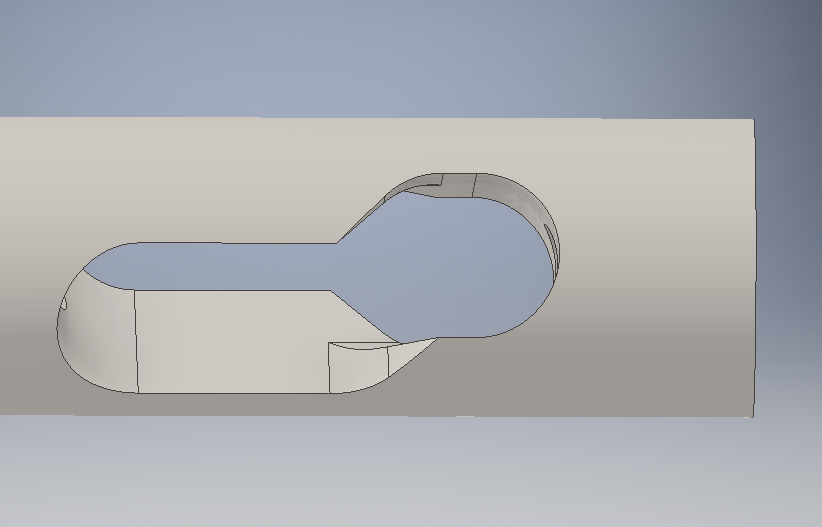
Instead of trying to work on yours I will let you have my file. You can use it as a guide. I've changed it to match most of your dimensions so you should be able to see what needs to be done. There are 7 extrusions required to produce the twisted slot:
2 simple obround slots that must overlap. (Yours didn't overlap and that was part of the problem.)
4 triangular extrusions. 2 out the front and then 2 out the back where the obround slots overlap.
finally 1 simple round extrusion down the center to clean things up.
I have several thoughts on this. The clearance through the offset portion of the slot is only about 5.8mm as I have it. You need to consider what is moving through that area and decide if that is sufficient clearance. This part is not impossible to manufacture but it is going to be difficult. It looks like it is part of the bolt mechanism for a rifle. I can think of better ways to design this to make it easier to manufacture as well as operate better.
Often times on a part like this we get caught up on the mechanical design, Then how it is drawn. Then on how its made. Then making it actually work. Manufacturing this part is going to take multiple setups on multiple pieces of equipment and may even require custom tooling.
The process ought to be the reverse. What does it need to do? And just as important, how are you going to make it? The last and least important part of the process ought to be how we create the CAD model. When you work on the process in this order, the CAD model not only represents the finished part but also becomes a representation of the manufacturing process. Problems like you have encountered almost solve themselves as you think in terms of tool paths and other manufacturing processes. The part performs better, It is easier to manufacture. And it becomes easier to design as well.