Learn about the GrabCAD Platform
Get to know GrabCAD as an open software platform for Additive Manufacturing
Visit our new homepage
Home
Control
Shop
Streamline Pro
Partner Program
Print
Community
Log in
Library
Challenges
Groups
Questions
Tutorials
Engineers
Blog
Log in
Learn from thousands of free Tutorials.
New user?
Join the community
or
log in.
Tutorials
Most liked all time
Recent
Most liked
Most viewed
Most commented
This week
This month
All time
Category
Design & CAD
Modeling
Drafting
Assemblies
BOM
Dimensioning / Tolerancing
Translations
Manufacturing & CAM
3D Printing
Tooling
NC Machining
Composites
Measurement / Inspection
Simulation & CAE
FEM
CFD
Kinematics
Process Simulation
Engineering Fundamentals
Theory
Process
Standards
Other
Software
Snagit
Alibre Design
ArchiCAD
AutoCAD
AutoCAD Electrical
Autodesk 3ds Max
Autodesk Alias
Autodesk Inventor
Autodesk Maya
Autodesk Revit
Autodesk 123D
BricsCAD
Bentley MicroStation
BlenderCAD
BobCAD-CAM
CATIA
Delmia
DraftSight
FreeCAD
Femap
Fusion 360
Geomagic Design
IronCAD
JT
Kompas-3D
KeyCreator
KeyShot
Lagoa
Luxology
Mastercam
Moi3D
NX Unigraphics
OBJ
Onshape
OpenSCAD
Parasolid
Powermill
Powershape
Pro/Engineer Wildfire
PTC Creo Parametric
PTC Creo Elements
Rhino
SpaceClaim
SOLIDWORKS
solidThinking Evolve
Solid Edge
SolidFace
STEP / IGES
SketchUp
STL
TopSolid
TinkerCAD
T-Flex CAD
TurboCAD
VectorWorks
ViaCAD 3D
VRML / WRL
ZW3D
GrabCAD Print
Rendering
GrabCAD Community
GrabCAD Workbench
Text file
3D Manufacturing Format
Cinema 4D
Other
Skill level
All levels
Beginner
Intermediate
Expert
DraftSight
×
Rhino
×
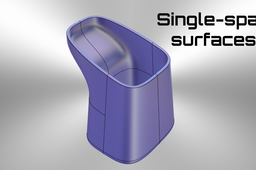
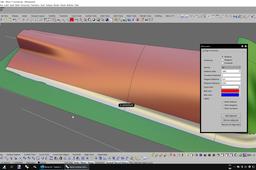
Rhino amateur creates a single-span model
Bobi
in
Modeling
0
0
Intermediate
Note: Since Rhino is unable to properly loose offset single-span degree 5 surface and creates chaotic output surfaces, I used an old “hack” with using the hugely underappreciated “MoveUVN” tool to offset the control points instead. That results into almost flawless loose offset surfaces that need just a few touches to maintain their tangency along the border.
Rhino
vase
box
package
moulding
rhino
class-a
bezier
single-span
How to build a quality blend curve on surface
Bobi
in
Modeling
0
0
Beginner
How to build a quality blend curve on surface.
Rhino
proper
perfect
smooth
quality
build
surface
surve
blend
Full round fillet between 3 surfaces
Bobi
in
Modeling
0
0
Beginner
This tutorial shows how to use a tangent circle to 3 surfaces to build a full round fillet in-between.
Rhino
rhino
radius
surface
surfacing
nurbs
transition
round
fillet
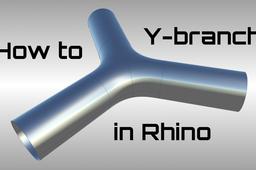
Modeling of Y-branch in Rhino 7
Bobi
in
Modeling
0
0
Expert
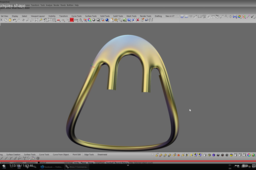
Modeling of Y-branch in Rhino 7
Rhino
pro
advanced
smooth
pipe
match
perfect
surface
blend
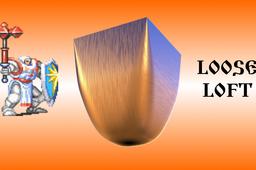
Clean, easy to edit shape with Loose Loft
Bobi
in
Modeling
0
0
Beginner
Clean, easy to edit shape with Loose Loft
Rhino
nice
industrial
design
box
smooth
blend
surface
loft
assemblies
Lucius R.B
in
Assemblies
0
0
Beginner
framing assemble in rhino
Rhino
how set the system language
Jeverson Fronza
in
Design & CAD
0
0
Intermediate
To set the system language
DraftSight
How to see System Variables list in DraftSight ?
Vid Ing
in
Design & CAD
0
0
Intermediate
Use SETVARIABLE command .
DraftSight
setvar
variables
system
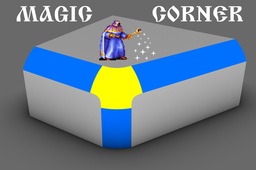
Magic corner in Rhino 7
Bobi
in
Modeling
0
0
Intermediate
Magic corner in Rhino 7
Rhino
pipe
design
transition
fillet
smooth
surface
blend
corner
Basic surfacing for Boat hull
Bobi
in
Modeling
0
0
Intermediate
Basic surfacing for Boat hull
Rhino
surface
pro
fillet
blend
marine
yacht
hull
boat
Helix around a freeform object
Bobi
in
Modeling
0
0
Beginner
Create helix around a freeform object.
Rhino
around
wrap
freeform
spring
spyral
helix
vase
rhino
How to create a ring in Rhino
Bobi
in
Modeling
0
0
Intermediate
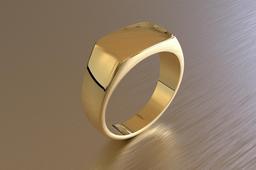
Modeling tutorial for creating a ring in Rhino 7.
Rhino
tip
jewerly
surfacing
nurbs
tutorial
rhino
modeling
ring
Modeling tutorial: Fixing a messy 3d model
Bobi
in
Modeling
0
0
Intermediate
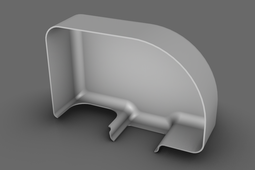
Modeling tutorial: Fixing a messy 3d model
Rhino
safe
smooth
perfect
round
fix
blend
fillet
box
Complex shape
Bobi
in
Modeling
0
0
Intermediate
Creating a freeform complex shape in Rhino.
Rhino
chair
print
cad
milling
cnc
solution
complex
freeform
"Failsafe" ESPHome Fireplace Controller
John McManigle
in
Assemblies
0
0
Intermediate
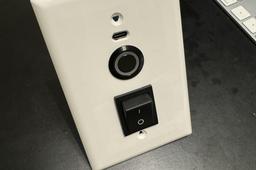
When asked what smart switch to use to control their gas fireplace, you see a lot of replies "do you want to be one software bug away from your fireplace turning on?" Granted, modern gas fireplaces have safeties in place to prevent un-lit open valves, runaway heating, etc., but some people would still rather have a hardware switch standing between them and fire. This project aims to be the best of both worlds: by running 5v power to the low-voltage switch box holding my fireplace wall switch (in my case, this involved pulling 5-conductor thermostat wire using the existing 2-conductor wire), you can power an ESP board running ESPHome. By running the actual thermostat switch signal through both a DPST and a (ESPHome-controlled) 3v relay, we can be sure that the fireplace is only "active" if the manual switch is turned on.
Rhino
smart home
rhino
esphome
home assistant
fireplace
1
2
3
4
5