Learn about the GrabCAD Platform
Get to know GrabCAD as an open software platform for Additive Manufacturing
Visit our new homepage
Home
Control
Shop
Streamline Pro
Partner Program
Print
Community
Log in
Library
Challenges
Groups
Questions
Tutorials
Engineers
Blog
Log in
Learn from thousands of free Tutorials.
New user?
Join the community
or
log in.
Tutorials
Most liked all time
Recent
Most liked
Most viewed
Most commented
This week
This month
All time
Category
Design & CAD
Modeling
Drafting
Assemblies
BOM
Dimensioning / Tolerancing
Translations
Manufacturing & CAM
3D Printing
Tooling
NC Machining
Composites
Measurement / Inspection
Simulation & CAE
FEM
CFD
Kinematics
Process Simulation
Engineering Fundamentals
Theory
Process
Standards
Other
Software
Snagit
Alibre Design
ArchiCAD
AutoCAD
AutoCAD Electrical
Autodesk 3ds Max
Autodesk Alias
Autodesk Inventor
Autodesk Maya
Autodesk Revit
Autodesk 123D
BricsCAD
Bentley MicroStation
BlenderCAD
BobCAD-CAM
CATIA
Delmia
DraftSight
FreeCAD
Femap
Fusion 360
Geomagic Design
IronCAD
JT
Kompas-3D
KeyCreator
KeyShot
Lagoa
Luxology
Mastercam
Moi3D
NX Unigraphics
OBJ
Onshape
OpenSCAD
Parasolid
Powermill
Powershape
Pro/Engineer Wildfire
PTC Creo Parametric
PTC Creo Elements
Rhino
SpaceClaim
SOLIDWORKS
solidThinking Evolve
Solid Edge
SolidFace
STEP / IGES
SketchUp
STL
TopSolid
TinkerCAD
T-Flex CAD
TurboCAD
VectorWorks
ViaCAD 3D
VRML / WRL
ZW3D
GrabCAD Print
Rendering
GrabCAD Community
GrabCAD Workbench
Text file
3D Manufacturing Format
Cinema 4D
Other
Intermediate
All levels
Beginner
Intermediate
Expert
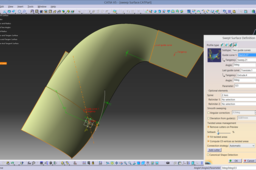
detail explanation of sweep surfacing command ..........all types explane plz....
QAPGAN™
in
Design & CAD
2
0
Intermediate
Here is the all sweep surfacing commands with images in CatPart created. :)
CATIA
photo's to 3d model
QAPGAN™
in
Design & CAD
2
0
Intermediate
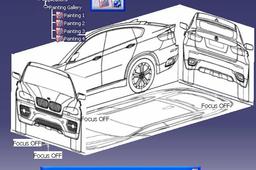
You will be taken in to Sketch Tracer work branch. Save it with a appropriate name. It is a Catproduct file.
CATIA
How to convert an assembly into one solid model (single body) IN cATIA?
Anirban Ghosh
in
Design & CAD
2
3
Intermediate
Follow these steps
CATIA
how to have dimensions locked by default once i modify the value
Mohit Saxena
in
Design & CAD
2
0
Intermediate
Tutorial: "how to have dimensions locked by default once i modify the value"
PTC Creo Parametric
creo
sketch
add decal and image in creo parametric 2
Huy Pham
in
Design & CAD
2
0
Intermediate
I hope it may be helpful
PTC Creo Parametric
How to us Curve Driven Pattern in solidwork?
HSN_ADI
in
Design & CAD
2
0
Intermediate
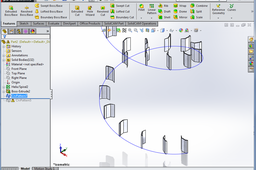
Hi Dorit, The problem is : You are trying to create separate features that solidworks calls them bodies The answer : Select bodies to pattern instead of feature as i did it. And i attached the final file here :
SOLIDWORKS
driven
pattern
curve
How can I change a language in SolidWorks?
Vadym Chabanov
in
Design & CAD
2
0
Intermediate
You can change language by changing windows system language in Control panel -> Regional and language options -> Administrative -> Change system lacale to French. Restart SolidWorks. But you must have French language installed in SolidWorks.
SOLIDWORKS
How to convert a CAD file to an STL file?
GrabCAD Tutorials
in
Design & CAD
2
1
Intermediate
STL is the standard file type used by most or all rapid prototyping systems. A STL is a triangulated representation of a 3D CAD model (figure 1). The triangulation of a surface will cause faceting of the 3D model. The parameters used for outputting a STL will affect how much faceting occurs (figure 2 and 3). You cannot build the model any better or smoother than the STL file, so if the STL is coarse and faceted, that is what you can expect in the final model. In the CAD package, when exporting to STL, you may see parameters for chord height, deviation, angle tolerance, or something similar. These are the parameters that affect the faceting of the STL.You don’t necessarily want to go too small. The finer the STL the larger the file is in size, which will affect processing time in Insight as well as build time. Below is some information found on the Internet regarding exporting to STL from various CAD packages.
AutoCAD
think3
deskartes-3d
datacad
cadkey
expert
studio
data
rhinoceros
revit
pro
stl
autodesk
sketchup
wildfire
solidedge
max
ironcad
inventor
cad
desktop
3d
mechanical
autocad
solidworks
alibre
nx
unigraphics
How to add(Make on one body ) surface area with solid part ?? ( Help to make mold in solid works )
Sahedul Abedin
in
Design & CAD
2
0
Intermediate
Custom Mold Insert Design
SOLIDWORKS
Fork lift vehicle design
MANIKANTHA P
in
Modeling
2
0
Intermediate
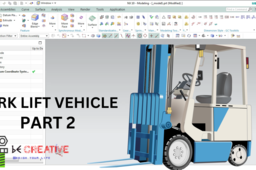
Fork lift vehicle design
NX Unigraphics
spm design
vehicle design
design
vehicle
nx
sport rims
Mahmoud Hegazey
in
Modeling
2
0
Intermediate
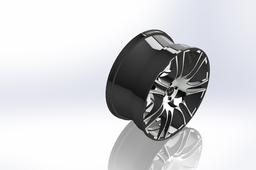
Excited to Share My Latest Project: Sport Rim Design in SolidWorks! I’m thrilled to announce the completion of my latest design project—high-performance sport rims created using SolidWorks! ### Key Features: - **Lightweight Construction**: Optimized to enhance vehicle performance and fuel efficiency. - **Durability**: Engineered with materials that withstand the rigorous demands of racing. - **Aerodynamic Design**: Crafted to reduce drag and improve airflow, contributing to overall performance. ### Design Process: Starting from initial sketches to 3D modeling, I utilized SolidWorks to bring my vision to life. The design underwent thorough simulation and analysis to ensure structural integrity and performance under load. ### Final Touches: The rims are designed with a sleek matte black finish, available in multiple sizes for various vehicles. I can’t wait to see these rims on the track, combining style with functionality! Feel free to reach out if you’d like to discuss the design process or any collaborative opportunities! #SolidWorks #DesignEngineering #AutomotiveDesign #SportRims #Innovation #EngineeringExcellence
SOLIDWORKS
sport
sportrims
solidworks
CATIA V5 | Sheetmetal design tutorial | Square Hopper
THE CAD SPIDER
in
Modeling
2
0
Intermediate
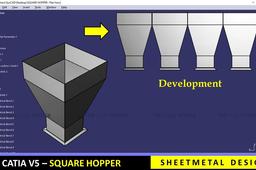
This tutorial contains step by step procedure to design a Square Hopper using Generative Sheetmetal design in CATIA V5 software. Further doubts enter in comment section..
CATIA
catia hopper tutorials
square hopper
sheetmetal design
catia sheetmetal design
catia tutorials
catia
Solidworks Tutorial - 3D Modeling Locking Shaft Stand w/ Revolve + 3-View Drawing + Section View & Dimensioning
Jonathan R Lovell
in
Modeling
2
0
Intermediate
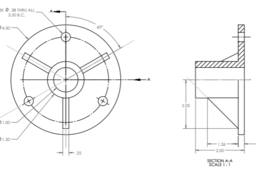
Intermediate Solidworks Tutorial On How To CAD 3D Model A Locking Shaft Stand Using A Revolve Boss Base. Then How to Correctly Produce a 3-View Basic Drawing w/ Added Isometric View. Included A How To On Section Views and Correct Dimensioning on Blueprint for Fabrication. https://youtu.be/JRjvYzDfNes?feature=shared Please Comment and Let Me Know What Thoughts You Have and What You Would Like Me To Do Next!!!
SOLIDWORKS
solidworks tutorial
locking shaft stand
cad
dimensioning
drawing
revolve boss base
3d modeling
section view
SolidWorks | 3D CAD EXERCISES 764 | StudyCadCam | Solution Tutorial |
Mahmud Hasan Maraj
in
Modeling
2
0
Intermediate
Let's see this 3D CAD EXERCISE. In this section we will make this part using various tools in SolidWorks. Chapters: 00:00 - Intro & view of the 3d model 00:15 - 3D Cad Exercise 764 34:16 - End Screen, Suggested Videos & Playlist You can also see other videos, ANSYS - Finite Element Modeling and Simulation https://www.youtube.com/playlist?list=PL1MUQa6T9kPfHpMcIza0MoM0kZYlbg-EG 3D CAD EXERCISES - STUDYCADCAM: https://www.youtube.com/playlist?list=PL1MUQa6T9kPc-kMMipt1CX5X1jnAYYwy6 SolidWorks Playlist: https://youtube.com/playlist?list=PL1MUQa6T9kPfgkhr-0B1MzA1p-tsxWW34 #MHM #SolidWorks
SOLIDWORKS
solidworks practice exercises
solidworks tutorial
studycadcam
3d cad exercises 764
solidworks
Solidworks Miter Flange | Calculate Blank Size in Solidworks | Export Solidworks File to AutoCAD DXF | CADable | CADable tutorials
Ibrahim Omer
in
Design & CAD
2
2
Intermediate
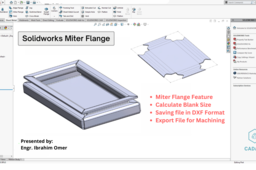
Welcome back to CADable with Engr. Ibrahim Omer! In today's tutorial, we're diving into a crucial feature in SolidWorks sheet metal: the miter flange. No worries if you're new – we'll walk through it step by step with an example. First up, we'll draw a rectangle and then transform it into a base flange/tab. Remember, miter flanges are a bit different from edge flanges – they need a sketch. We'll sketch four lines and tweak some settings to create a simple sheet metal box. Once our box is ready, it's time to figure out the blank size. We'll use the 'flatten' command for this. Next step? Exporting the file to machining software for cutting – think laser, wire cut, or EDM. We'll save it in DXF format, ready to go. Chapters of the tutorial: Introduction 0:00 Sketching centre rectangle 0:23 Sheetmetal base flange/tab feature 0:40 Creating sketch for miter flange 0:55 Solidworks miter flange feature 1:31 Calculate blank size of the box 2:32 Saving file in DXF format for machining 2:43 Conclusion 3:22 This tutorial is perfect for beginners looking to sharpen their skills. Take your time, hit pause if needed, and don't hesitate to drop your questions in the comments. Remember, practice makes perfect! Don't forget to subscribe to our channel for more tutorials like this: https://www.youtube.com/c/CADable #solidworkssheetmetal #solidworksmiterflange #miterflangesolidworks #blanksizeinsolidworks #CADable #CADabletutorials
SOLIDWORKS
how to use miter flange feature
cadable tutorials
cadable
export solidworks file to autocad dxf
calculate blank size in solidworks
solidworks miter flange
1
…
98
99
100